
Baker & McKenzie International Arbitration Yearbook: 2010-2011
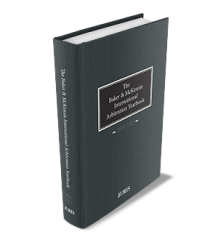
This is the fourth edition of the Baker & McKenzie International Arbitration Yearbook, an annual series established by the Firm in 2007. This collection of articles is comprised of reports in key jurisdictions around the globe on arbitration. Leading lawyers of the Firm’s International Arbitration Practice Group, a division of the Firm’s Global Dispute Resolution Practice Group, report on recent developments in national laws relating to arbitration and address current arbitral trends and tendencies in the jurisdictions in which they practice.
This Yearbook highlights the more important recent developments in international arbitration, without aspiring to be an exhaustive case reporter or a text-book to arbitration in the broad sense. This volume will prove a useful tool for those contemplating and using arbitration to resolve international business disputes.
PDF of Title Page and T.O.C.
Foreword
ABOUT THE 2010-2011 B&M YEARBOOK EDITORS
Executive Editor:
Nancy M. Thevenin is Special Counsel in the New York office of Baker & McKenzie and the global coordinator of the Firm’s International Arbitration Practice Group. She routinely advises on arbitration institutions, mediation, disputes boards and expertise proceedings, ad hoc cases and use of pre-arbitral referee procedures. Her experience includes handling international commercial mediation and arbitration under the auspices of the AAA, ICC and ICDR. Ms. Thevenin has handled disputes in various industries, including construction and engineering, financial services, commercial real estate and aviation, often involving issues concerning M&A, sales, distribution, licensing, technology transfer and leasing agreements. She currently serves as co-chair of the International Arbitration & ADR Committee of the International Law Section of the New York State Bar Association, vice-chair of the Arbitration Law Committee of the Inter-American Bar Association and executive committee member of the American Branch of the International Law Association. Before joining Baker & McKenzie, Ms. Thevenin served as deputy director of arbitration and ADR for North America for the ICC International Court of Arbitration in New York.
ABOUT THE 2010-2011 B&M YEARBOOK EDITORS
Emmanuel Buenaventura is a Partner in the Manila office of Baker & McKenzie. He is member of the Dispute Resolution and the International Arbitration practice groups, head of the Telecommunications, Transportation & Logistics Industry Group, and lead Lawyer for arbitration/litigation of the Mining Focus Group. He has advised or represented multinational corporations in general litigation (commercial, civil and criminal), tax and customs controversies, corporate rehabilitation and insolvency, arbitration and alternative dispute resolution, maritime law, employment appeals, intellectual property litigation, sanctions proceedings before international organizations, and administrative proceedings. He is the incumbent Vice-President of the Integrated Bar of the Philippines-Oriental Mindoro Chapter (where he previously served as President and Delegate to the IBP National House of Delegates), and the Executive Vice President and Trustee of the Maritime Law Association of the Philippines.
Timothy Cooke is a Partner in the Singapore office of Baker & McKenzie. Mr. Cooke has been practicing in the area of dispute resolution since 2000. A Barrister called to the English Bar, he has advised clients in a wide variety of commercial disputes, particularly in the areas of oil and gas, insurance and reinsurance, telecommunications, engineering and construction, banking and trusts. He has represented clients before the High Courts of England and Wales, before the Judicial Committee of the Privy Council and in international arbitrations in Singapore, the United Kingdom, the Cayman Islands and the British Virgin Islands in accordance with the rules of the major arbitration institutions, including the ICC, LCIA, LMAA, SIAC, and in ad hoc arbitration under UNCITRAL Rules.
Grant Hanessian is a Partner in the New York office of Baker & McKenzie. Mr. Hanessian serves as Co-chair of the Firm’s International Arbitration Practice Group and Chair of the Litigation/Dispute Resolution department of the New York office. He has more than 25 years of experience serving as counsel and arbitrator in disputes concerning contract, energy, construction, commodities, financial services, insurance, intellectual property and other matters. Mr. Hanessian is a member of the Commission on Arbitration of the ICC and the ICC Task Force on Arbitration Involving States or State Entities, as well as the American Society of International Law, American Bar Association, Association of the Bar of the City of New York, American Arbitration Association and London Court of International Arbitration. He is an Editor of this publication and Co-editor of the Gulf War Claims Reporter (ILI/Kluwer, 1998) and International Arbitration Checklists (Juris Pub., 2d ed., 2008).
Jean-Pierre Harb is a Partner in the Paris office of Baker & McKenzie and a member of the Firm’s International Arbitration Practice Group. Mr. Harb practices in the areas of international commercial arbitration, construction law and alternative dispute resolution, routinely representing clients in ad hoc and institutional international arbitrations. He has advised major construction companies on contractual issues arising from infrastructure projects, and has significant experience working in jurisdictions beyond France, including China, Saudi Arabia and Greece. He is a member of the Paris Bar Association.
Vladimir Khvalei is a Partner in the Moscow office of Baker & McKenzie. Mr. Khvalei is steering committee member of the Firm’s International Arbitration Practice Group and heads the Firm’s CIS Dispute Resolution Practice Group in Moscow. He handles international arbitration cases as Party Counsel and Arbitrator, particularly with respect to the arbitration rules of the ICC, ICAC (MKAS), SCC and UNCITRAL. Mr. Khvalei has extensive experience in dispute resolution in Russia, Kazakhstan, Belarus and Ukraine. He also serves as a Vice President of the ICC International Court of Arbitration, a Board member of the International Arbitration Court at the Belarusian Chamber of Commerce and Industry and is included in the list of arbitrators of the arbitration institutions in Russia, Austria, Poland, Belarus and Kazakhstan. Mr. Khvalei is Chairman of the Arbitration Commission of the Russian National Committee of ICC and a registered tutor of the Chartered Institute of Arbitrators. He is a regular speaker at a number of conferences relating to international trade law and arbitration.
Frank Kroes is a Partner in the Amsterdam office of Baker & McKenzie. Mr. Kroes specializes in complex commercial litigation and national and international arbitration. He represents clients from a wide variety of industry sectors both before the state courts and in national and international arbitrations administered by a range of leading arbitration institutions. His work includes energy, construction, chemicals, the financial sector, class actions and private antitrust litigation. Mr. Kroes is affiliated with the Dutch Association for Procedural Law, Dutch Association for Civil Law, Association for Corporate Litigation, Dutch Association for Energy Law and Dutch Bar Association. In addition to his practice, he is a frequent Lecturer and Presenter on matters such as product liability, class actions and international arbitration.
Jürgen Mark is a Partner in the Düsseldorf office of Baker & McKenzie. Mr. Mark is a member of the Firm’s Europe Dispute Resolution Practice Group Steering Committee. His practice covers a wide range of domestic and international disputes involving both litigation and arbitration in the areas of commercial and company law, product liability law and distribution law. He has handled complex litigation, as well as ICC, DIS and ad hoc arbitrations. Mr. Mark has also acted as Arbitrator on arbitration panels for the ICC and DIS relating to corporate and post M&A disputes, major construction projects, product distribution and product liability. He is a member of the German Lawyer’s Association, International Bar Association, German Institution of Arbitration (DIS), London Court of International Arbitration, Swiss Arbitration Association, International Law Association, German Association for Intellectual Property & Copyright, German-American Lawyers’ Association and Canadian-German Lawyers’ Association.
Günter Pickrahn is Partner in the Frankfurt office of Baker & McKenzie. Mr. Pickrahn is Co-chair of Firm’s International Arbitration Practice Group and Leader of the European Dispute Resolution Steering Committee. His arbitration practice is wideranging and includes all aspects of commercial, domestic and international disputes. He has acted for clients in more than 50 arbitral proceedings as a Party Representative, mostly in postacquisition disputes and other commercial matters. He also has experience as an Arbitrator, both as Chair and Party-Appointed Arbitrator. He has particular expertise in intellectual property matters, most notably patent-related disputes, and serves as Arbitrator in WIPO and other such arbitration proceedings. He is an active member of the German Institute for Arbitration, the Swiss Association for Arbitration, the London Court of International Arbitration, and the German Association for Intellectual Property Rights and Copyright.
Edward Poulton is a Partner in the London office of Baker & McKenzie. Mr. Poulton is a member of the Firm’s Dispute Resolution Practice Group. He focuses his practice in international arbitration, complex litigation, commercial and investment treaty arbitration, and public international law. His experience ranges from contract and M&A disputes to more specialist claims in the banking sector and investment treaty claims. He has acted as Advisor and Advocate in many international arbitrations under the rules of the major arbitral institutions. Mr. Poulton’s client base covers a wide range of sectors, including financial services, electronics, aviation and telecommunications. He is a member of the Law Society of England & Wales, ICC, LCIA, Young International Arbitration Group and Investment Protection Forum of the British Institute of International and Comparative Law.
Mathias Wittinghofer is a Partner in the Frankfurt office of Baker & McKenzie. Mr. Wittinghofer is a member of the Firm’s Global Dispute Resolution Practice Group. A member of the Chartered Institute of Arbitrators and double-qualified as a German Attorney-at-Law and a Solicitor (England & Wales), Mr. Wittinghofer routinely handles international arbitration proceedings, most notably in the areas of post-mergers and acquisitions and banking and finance dispute resolution. He has handled a wide variety of disputes both before German state courts, as well as in national and international arbitrations before all major arbitral institutions. His clients include international corporations as well as banks, private equity firms and other members of the banking & finance industry. Mr. Wittinghofer has published several articles and spoken extensively on the topic of international arbitration, and recently completed the theoretical training required to qualify as a Fachanwalt für Bankund Kapitalmarktrecht (specialist banking and finance lawyer).
David Zaslowsky is a Partner in the New York office of Baker & McKenzie. Mr. Zaslowsky practices general commercial litigation and arbitration and has worked on many cases involving matters related to the Foreign Sovereign Immunities Act, enforcement of foreign arbitral awards, Alien Tort Claims Act, forum non conveniens, obtaining discovery in aid of foreign proceedings under 28 U.S.C. § 1782 and foreign attachments. Mr. Zaslowsky has appeared in various federal and state courts – trial and appellate – throughout the country. He has also participated in arbitrations, both inside and outside the United States, under the rules of various arbitral institutions including the AAA, ICC, Iran-United States Claims Tribunal, ICDR and NASD, as well as ad hoc arbitrations. Mr. Zaslowsky is also on the panel of international arbitrators of the ICDR and is a member of the Association of the Bar of the City of New York, New York State Bar Association and American Bar Association.
Urs Zenhäusern is a Partner in the Zurich office of Baker & McKenzie. Mr. Zenhäusern mainly handles commercial, transactional and intellectual property disputes before state courts and international arbitral tribunals. He has acted as sole Arbitrator, Chairman and Secretary of arbitration panels, and as a Counsel in domestic and international litigation and arbitration. He also advises clients on antitrust law and sports law, as well as legal matters related to unfair competition and distribution, agency and licensing contracts. Mr. Zenhäusern is a frequent writer and speaker at seminars on litigation and arbitration law, as well as intellectual property law topics. He is a member of the Swiss Arbitration Association, German Institution of Arbitration, International Bar Association, International Law Association, Licensing Executives Society, AIPPI and INGRES.
"The authors do a creditable job of providing a contemporaneous baseline of knowledge for each of the countries covered and thus a basis for high-level comparative analysis. In summary, and with some important caveats, this is a resource that is likely to provide utility to a range of individuals involved in international commerce, trade and investment. Those engaged in the negotiation of contracts, or the resolution of disputes as counsel or arbitrator, are all likely to find something of use, as are students of the subject matter."
-The Expert and Dispute Resolver (TEDR); review by Craig Kersey
ABOUT THE 2010-2011 B&M YEARBOOK EDITORS
Executive Editor:
Nancy M. Thevenin is Special Counsel in the New York office of Baker & McKenzie and the global coordinator of the Firm’s International Arbitration Practice Group. She routinely advises on arbitration institutions, mediation, disputes boards and expertise proceedings, ad hoc cases and use of pre-arbitral referee procedures. Her experience includes handling international commercial mediation and arbitration under the auspices of the AAA, ICC and ICDR. Ms. Thevenin has handled disputes in various industries, including construction and engineering, financial services, commercial real estate and aviation, often involving issues concerning M&A, sales, distribution, licensing, technology transfer and leasing agreements. She currently serves as co-chair of the International Arbitration & ADR Committee of the International Law Section of the New York State Bar Association, vice-chair of the Arbitration Law Committee of the Inter-American Bar Association and executive committee member of the American Branch of the International Law Association. Before joining Baker & McKenzie, Ms. Thevenin served as deputy director of arbitration and ADR for North America for the ICC International Court of Arbitration in New York.
ABOUT THE 2010-2011 B&M YEARBOOK EDITORS
Emmanuel Buenaventura is a Partner in the Manila office of Baker & McKenzie. He is member of the Dispute Resolution and the International Arbitration practice groups, head of the Telecommunications, Transportation & Logistics Industry Group, and lead Lawyer for arbitration/litigation of the Mining Focus Group. He has advised or represented multinational corporations in general litigation (commercial, civil and criminal), tax and customs controversies, corporate rehabilitation and insolvency, arbitration and alternative dispute resolution, maritime law, employment appeals, intellectual property litigation, sanctions proceedings before international organizations, and administrative proceedings. He is the incumbent Vice-President of the Integrated Bar of the Philippines-Oriental Mindoro Chapter (where he previously served as President and Delegate to the IBP National House of Delegates), and the Executive Vice President and Trustee of the Maritime Law Association of the Philippines.
Timothy Cooke is a Partner in the Singapore office of Baker & McKenzie. Mr. Cooke has been practicing in the area of dispute resolution since 2000. A Barrister called to the English Bar, he has advised clients in a wide variety of commercial disputes, particularly in the areas of oil and gas, insurance and reinsurance, telecommunications, engineering and construction, banking and trusts. He has represented clients before the High Courts of England and Wales, before the Judicial Committee of the Privy Council and in international arbitrations in Singapore, the United Kingdom, the Cayman Islands and the British Virgin Islands in accordance with the rules of the major arbitration institutions, including the ICC, LCIA, LMAA, SIAC, and in ad hoc arbitration under UNCITRAL Rules.
Grant Hanessian is a Partner in the New York office of Baker & McKenzie. Mr. Hanessian serves as Co-chair of the Firm’s International Arbitration Practice Group and Chair of the Litigation/Dispute Resolution department of the New York office. He has more than 25 years of experience serving as counsel and arbitrator in disputes concerning contract, energy, construction, commodities, financial services, insurance, intellectual property and other matters. Mr. Hanessian is a member of the Commission on Arbitration of the ICC and the ICC Task Force on Arbitration Involving States or State Entities, as well as the American Society of International Law, American Bar Association, Association of the Bar of the City of New York, American Arbitration Association and London Court of International Arbitration. He is an Editor of this publication and Co-editor of the Gulf War Claims Reporter (ILI/Kluwer, 1998) and International Arbitration Checklists (Juris Pub., 2d ed., 2008).
Jean-Pierre Harb is a Partner in the Paris office of Baker & McKenzie and a member of the Firm’s International Arbitration Practice Group. Mr. Harb practices in the areas of international commercial arbitration, construction law and alternative dispute resolution, routinely representing clients in ad hoc and institutional international arbitrations. He has advised major construction companies on contractual issues arising from infrastructure projects, and has significant experience working in jurisdictions beyond France, including China, Saudi Arabia and Greece. He is a member of the Paris Bar Association.
Vladimir Khvalei is a Partner in the Moscow office of Baker & McKenzie. Mr. Khvalei is steering committee member of the Firm’s International Arbitration Practice Group and heads the Firm’s CIS Dispute Resolution Practice Group in Moscow. He handles international arbitration cases as Party Counsel and Arbitrator, particularly with respect to the arbitration rules of the ICC, ICAC (MKAS), SCC and UNCITRAL. Mr. Khvalei has extensive experience in dispute resolution in Russia, Kazakhstan, Belarus and Ukraine. He also serves as a Vice President of the ICC International Court of Arbitration, a Board member of the International Arbitration Court at the Belarusian Chamber of Commerce and Industry and is included in the list of arbitrators of the arbitration institutions in Russia, Austria, Poland, Belarus and Kazakhstan. Mr. Khvalei is Chairman of the Arbitration Commission of the Russian National Committee of ICC and a registered tutor of the Chartered Institute of Arbitrators. He is a regular speaker at a number of conferences relating to international trade law and arbitration.
Frank Kroes is a Partner in the Amsterdam office of Baker & McKenzie. Mr. Kroes specializes in complex commercial litigation and national and international arbitration. He represents clients from a wide variety of industry sectors both before the state courts and in national and international arbitrations administered by a range of leading arbitration institutions. His work includes energy, construction, chemicals, the financial sector, class actions and private antitrust litigation. Mr. Kroes is affiliated with the Dutch Association for Procedural Law, Dutch Association for Civil Law, Association for Corporate Litigation, Dutch Association for Energy Law and Dutch Bar Association. In addition to his practice, he is a frequent Lecturer and Presenter on matters such as product liability, class actions and international arbitration.
Jürgen Mark is a Partner in the Düsseldorf office of Baker & McKenzie. Mr. Mark is a member of the Firm’s Europe Dispute Resolution Practice Group Steering Committee. His practice covers a wide range of domestic and international disputes involving both litigation and arbitration in the areas of commercial and company law, product liability law and distribution law. He has handled complex litigation, as well as ICC, DIS and ad hoc arbitrations. Mr. Mark has also acted as Arbitrator on arbitration panels for the ICC and DIS relating to corporate and post M&A disputes, major construction projects, product distribution and product liability. He is a member of the German Lawyer’s Association, International Bar Association, German Institution of Arbitration (DIS), London Court of International Arbitration, Swiss Arbitration Association, International Law Association, German Association for Intellectual Property & Copyright, German-American Lawyers’ Association and Canadian-German Lawyers’ Association.
Günter Pickrahn is Partner in the Frankfurt office of Baker & McKenzie. Mr. Pickrahn is Co-chair of Firm’s International Arbitration Practice Group and Leader of the European Dispute Resolution Steering Committee. His arbitration practice is wideranging and includes all aspects of commercial, domestic and international disputes. He has acted for clients in more than 50 arbitral proceedings as a Party Representative, mostly in postacquisition disputes and other commercial matters. He also has experience as an Arbitrator, both as Chair and Party-Appointed Arbitrator. He has particular expertise in intellectual property matters, most notably patent-related disputes, and serves as Arbitrator in WIPO and other such arbitration proceedings. He is an active member of the German Institute for Arbitration, the Swiss Association for Arbitration, the London Court of International Arbitration, and the German Association for Intellectual Property Rights and Copyright.
Edward Poulton is a Partner in the London office of Baker & McKenzie. Mr. Poulton is a member of the Firm’s Dispute Resolution Practice Group. He focuses his practice in international arbitration, complex litigation, commercial and investment treaty arbitration, and public international law. His experience ranges from contract and M&A disputes to more specialist claims in the banking sector and investment treaty claims. He has acted as Advisor and Advocate in many international arbitrations under the rules of the major arbitral institutions. Mr. Poulton’s client base covers a wide range of sectors, including financial services, electronics, aviation and telecommunications. He is a member of the Law Society of England & Wales, ICC, LCIA, Young International Arbitration Group and Investment Protection Forum of the British Institute of International and Comparative Law.
Mathias Wittinghofer is a Partner in the Frankfurt office of Baker & McKenzie. Mr. Wittinghofer is a member of the Firm’s Global Dispute Resolution Practice Group. A member of the Chartered Institute of Arbitrators and double-qualified as a German Attorney-at-Law and a Solicitor (England & Wales), Mr. Wittinghofer routinely handles international arbitration proceedings, most notably in the areas of post-mergers and acquisitions and banking and finance dispute resolution. He has handled a wide variety of disputes both before German state courts, as well as in national and international arbitrations before all major arbitral institutions. His clients include international corporations as well as banks, private equity firms and other members of the banking & finance industry. Mr. Wittinghofer has published several articles and spoken extensively on the topic of international arbitration, and recently completed the theoretical training required to qualify as a Fachanwalt für Bankund Kapitalmarktrecht (specialist banking and finance lawyer).
David Zaslowsky is a Partner in the New York office of Baker & McKenzie. Mr. Zaslowsky practices general commercial litigation and arbitration and has worked on many cases involving matters related to the Foreign Sovereign Immunities Act, enforcement of foreign arbitral awards, Alien Tort Claims Act, forum non conveniens, obtaining discovery in aid of foreign proceedings under 28 U.S.C. § 1782 and foreign attachments. Mr. Zaslowsky has appeared in various federal and state courts – trial and appellate – throughout the country. He has also participated in arbitrations, both inside and outside the United States, under the rules of various arbitral institutions including the AAA, ICC, Iran-United States Claims Tribunal, ICDR and NASD, as well as ad hoc arbitrations. Mr. Zaslowsky is also on the panel of international arbitrators of the ICDR and is a member of the Association of the Bar of the City of New York, New York State Bar Association and American Bar Association.
Urs Zenhäusern is a Partner in the Zurich office of Baker & McKenzie. Mr. Zenhäusern mainly handles commercial, transactional and intellectual property disputes before state courts and international arbitral tribunals. He has acted as sole Arbitrator, Chairman and Secretary of arbitration panels, and as a Counsel in domestic and international litigation and arbitration. He also advises clients on antitrust law and sports law, as well as legal matters related to unfair competition and distribution, agency and licensing contracts. Mr. Zenhäusern is a frequent writer and speaker at seminars on litigation and arbitration law, as well as intellectual property law topics. He is a member of the Swiss Arbitration Association, German Institution of Arbitration, International Bar Association, International Law Association, Licensing Executives Society, AIPPI and INGRES.
"The authors do a creditable job of providing a contemporaneous baseline of knowledge for each of the countries covered and thus a basis for high-level comparative analysis. In summary, and with some important caveats, this is a resource that is likely to provide utility to a range of individuals involved in international commerce, trade and investment. Those engaged in the negotiation of contracts, or the resolution of disputes as counsel or arbitrator, are all likely to find something of use, as are students of the subject matter."
-The Expert and Dispute Resolver (TEDR); review by Craig Kersey
PDF of Title Page and T.O.C.
Foreword